


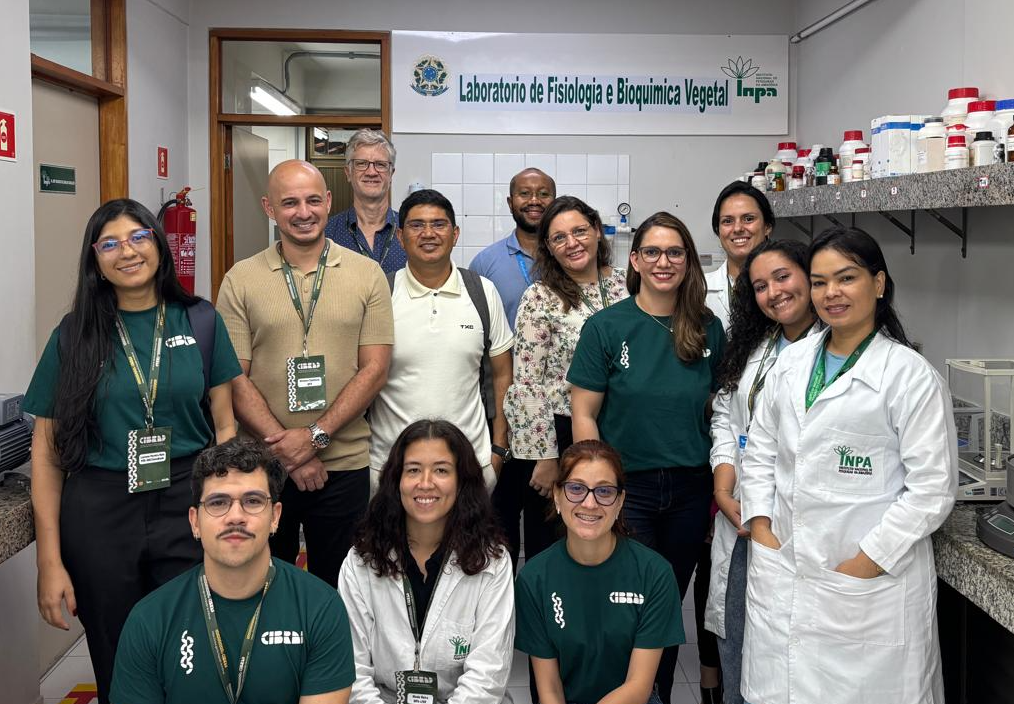
 Professor Mateus Santana, coordinator of the Graduate Program in Agricultural Microbiology (PPGMBA) at UFV, was in Manaus last week for the launch of the Center for Biotechnological Innovation for the Restoration of Degraded Areas (CIBRAD), an R$18.7 million project aimed at promoting the restoration of areas in the Amazon. Mateus is one of the project’s researchers. CIBRAD is a partnership between the Instituto Nacional de Pesquisas da Amazônia (INPA) and Shell Brazil.
Coordinated by INPA researcher José Francisco de Carvalho Gonçalves, the project will integrate scientific research, technological development, and innovation, with the participation of government agencies, the scientific community, companies, and startups. Among the initiatives are NanoRad’s 2.0, a project that applies bio and nanotechnological approaches to accelerate forest planting, and AmazonGeneBank, dedicated to supporting genetic improvement programs and the conservation of seeds and microorganisms from the Legal Amazon.
“At this early stage, we are conducting research on trees that will be used for reforestation, such as the Brazil nut tree, the rosewood tree, and the ingá tree. There are 10 native plants in total, with a focus on those that can generate economic activity,” explains Mateus, who works as a researcher on experimental design and the sequencing of microorganism genomes, as well as the identification and evaluation of the biotechnological potential of microorganisms. “We are now not only sequencing some of these plants but also prospecting for and isolating microorganisms associated with these plants in the forest. The intention is that, later, when we start producing them in the greenhouse, we will already be able to inoculate these microorganisms, so that the plants come with the microorganisms, which play an important role not only in reforestation but also in other biotechnological applications.”
Today, approximately 20% of the Amazon has been deforested, equivalent to 1 million square kilometers. In addition to strengthening production chains for native species, CIBRAD aims to conserve genetic resources and foster new businesses linked to forest restoration and the carbon market. In parallel with the projects led by INPA, the center also includes initiatives developed in partnership with startups, such as Krilltech.
Leave A Comment